
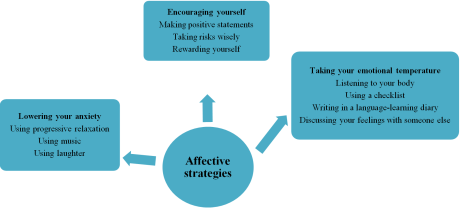
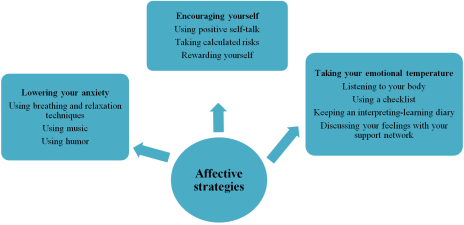
Although affective factors play a pivotal role in interpreting, this area is often under-researched. The regulation of emotions, as a key component of emotional intelligence, is relevant to interpreters’ competence and expertise, and can significantly affect the quality of translations. This article reports on a qualitative descriptive investigation into affective interpreting-learning strategies as a phenomenon by utilizing language-learning strategies for interpreter training. Unlike a typically problem-oriented interpreting strategy used during the interpreting process, an interpreting-learning strategy is not (necessarily) directly linked to the interpreting process, but aids interpreters in improving their foundational interpreting ability. The research question addressed is To what extent can language-learning strategies be utilized for interpreter training? Three theoretical points of departure are employed and discussed, namely psycho-affectivity and emotional intelligence in interpreting; Oxford’s ten affective language-learning strategies to regulate emotions; and the Affective Filter Hypothesis (anxiety, motivation, and self-confidence). Following a qualitative descriptive research methodology, affective interpreting-learning strategies are explained as a phenomenon. It is argued that the intersection between interpreting and language learning be explored for the redevelopment of affective interpreting-learning strategies from language-learning strategies so as to manage affect in interpreting. Based on the interaction between interpreting- and language-learning research, affective interpreting-learning strategies are redeveloped. These strategies can be used before, during, and after the interpreting task (during training as well as lifelong practice) to focus on internal psycho-affective factors in interpreting - mainly anxiety, motivation, and self-confidence - in order to maintain a low affective filter and develop emotional intelligence. Three strategy categories (lowering your anxiety level, encouraging yourself, and taking your emotional temperature) with ten individual affective interpreting-learning strategies are suggested for interpreter training. All ten strategies are discussed in depth, namely using breathing and relaxation techniques, using music, using humor, using positive self-talk, taking calculated risks, rewarding yourself, listening to your body, using a checklist, keeping an interpreting diary, and discussing your feelings with your support system. The results show that language-learning strategies can indeed be utilized extensively to redevelop affective interpreting-learning strategies for interpreter training, and that although interpreting and language learning are distinct disciplines of applied linguistics, they do complement each other.
| Published in | International Journal of Applied Linguistics and Translation (Volume 12, Issue 1) |
| DOI | 10.11648/j.ijalt.20261201.11 |
| Page(s) | 1-17 |
| Creative Commons |
This is an Open Access article, distributed under the terms of the Creative Commons Attribution 4.0 International License (http://creativecommons.org/licenses/by/4.0/), which permits unrestricted use, distribution and reproduction in any medium or format, provided the original work is properly cited. |
| Copyright |
Copyright © The Author(s), 2026. Published by Science Publishing Group |
Affective Filter Hypothesis, Affective Interpreting-Learning Strategies, Affective Language-Learning Strategies, Emotional Intelligence, Psycho-Affectivity
AFH | Affective Filter Hypothesis |
DCS | Demand-Control Schema |
SILL | Strategy Inventory for Language Learning |
SIIL | Strategy Inventory for Interpreting Learning |
| [1] | Dogan, A., Arumí Ribas, M., Mora?Rubio, B., Cat, M. Metacognitive Tools in Interpreting Training: A Pilot Study, Journal of Faculty of Letters. 2009, 26(1), 69-84. |
| [2] | Al-Harahsheh, A., Shehab, E., Al?Rousan, R. Consecutive Interpretation Training: Challenges and Solutions, Journal of Foreign Language Teaching and Translation Studies. 2020, 5(1), 85-102. |
| [3] | Korpal, P. Interpreting as a Stressful Activity: Physiological Measures of Stress in Simultaneous Interpreting, Poznań Studies in Contemporary Linguistics. 2016, 52(2), 297-316. |
| [4] | Rojo López, A. M., Caldwell?Harris, C. L. Emotions in Cognitive Translation and Interpreting Studies. In The Routledge Handbook of Translation, Interpreting and Bilingualism, Ferreira, A., Schwieter, J. W., Eds., London & New York, USA: Routledge; 2023, pp. 206-221. |
| [5] | Xu, Y., Liu, M. Relations Among and Predictive Effects of Anxiety, Enjoyment and Self-Efficacy on Chinese Interpreting Majors’ Self-Rated Interpreting Competence, Education Sciences. 2023, 13(5), 436. |
| [6] | González Campanella, A. Emotional Labour and Affective Skills in Public Service Interpreting: Expanding the Competence Models [Trabajo Emocional y Aptitudes Afectivas en la Interpretación en Servicios Públicos: Expandiendo los Modelos de Competencia], FITISPos International Journal. 2024, 11(1), 44-64. |
| [7] | Xi, R. Translating Emotions: A Netnography of Affect in a Conference Interpreting Case During COVID?19, Perspectives. 2024, 32(2), 345-ff. |
| [8] | Abdel Latif, M. M. M., Alhamad, M. M. Translation and Interpreting Self-Efficacy: A Review of Published Measures, Frontiers in Psychology. 2025, 16, 1632366. |
| [9] | Herring, R. E., Walczyński, M. Emotions, Stress and Related Phenomena in Public Service Interpreter and Translator Education and Training, FITISPos International Journal. 2024, 11(1), 9-27. |
| [10] | Van der Merwe, K. ’n Tolkaanleerstrategiemodel uit Taalaanleerstrategieë vir Prosesgerigte Tolkopleiding. Ph.D. Thesis, Stellenbosch University, Stellenbosch, South Africa, 2025. |
| [11] | Oxford, R. L. Language Learning Strategies: What Every Teacher Should Know. Boston, MA, USA: Heinle & Heinle; 1990. |
| [12] | Zhang, Y. Possible Ways to Make Interpretation Teaching More Effective, Journal of Contemporary Educational Research. 2020, 4(7), 39-42. |
| [13] | Cheng, S. Exploring the Role of Translators’ Emotion Regulation and Critical Thinking Ability in Translation Performance, Frontiers in Psychology. 2022, 13, 1037829. |
| [14] | Chen, T. The Interplay Between Psychological Well-Being, Stress, and Burnout: Implications for Translators and Interpreters, Heliyon. 2023, 9(8), e18589. |
| [15] | Johnson, J. E. Effect of Mindfulness Training on Interpretation Exam Performance in Graduate Students in Interpreting. Ph.D. Thesis, University of San Francisco, San Francisco, CA, USA, 2016. |
| [16] | Tran, T. T. T. Students’ Anxiety Levels in Interpretation Courses at a Tertiary Institution: How Teachers’ Intervention Helps, International Journal of Research and Innovation in Social Science. 2025, 9(3), 4652-4661. |
| [17] | Chiang, Y.-N., Villarreal, D. S. Foreign Language Learning Strategies and Consecutive Interpreting Achievement: An Exploratory Study on Taiwanese Interpreting Students, Meta: Journal des traducteurs. 2013, 58(1), 146-164. |
| [18] |
Bancroft, M. German News Translator Bursts into Tears While Reporting Ukrainian President Zelensky’s Speech. Available from:
https://www.theguardian.com/world/2022/feb/20/german-news-translator-bursts-into-tears-zelensky-speech (accessed 1 November 2025). |
| [19] | Dean, R. K., & Pollard, R. Q., Context?based Ethical Reasoning in Interpreting: A Demand Control Schema Perspective, The Interpreter and Translator Trainer. 2011, 5(1), 155-182. |
| [20] | Van Zyl Bekker, S. ’n Toepassing van die Teoretiese Konstruk van die Werkseis Beheerskema op Opvoedkundige Tolking: US as Gevallestudie. Master’s Thesis, Stellenbosch University, Stellenbosch, South Africa, 2019. |
| [21] | Holmgren, H., Søndergaard, H., Elklit, A. Stress and Coping in Traumatised Interpreters: A Pilot Study of Refugee Interpreters Working for a Humanitarian Organization, Intervention. 2003, 1(3), 22-27. |
| [22] | Monacelli, C. Self?Preservation in Simultaneous Interpreting. Amsterdam, Netherlands: John Benjamins; 2009. |
| [23] | Bontempo, K., Napier, J. Evaluating Emotional Stability as a Predictor of Interpreter Competence and Aptitude for Interpreting, Interpreting. 2011, 13(1), 85-105. |
| [24] | Cifuentes-Férez, P., Fenollar?Cortés, J. On the Impact of Self-Esteem, Emotion Regulation and Emotional Expressivity on Student Translators’ Performance, Vigo International Journal of Applied Linguistics. 2017, 14, 71-97. |
| [25] | Geiling, A., Knaevelsrud, C., Böttche, M., Stammel, N. Mental Health and Work Experiences of Interpreters in the Mental Health Care of Refugees: A Systematic Review, Frontiers in Psychiatry. 2021, 12, 710789. |
| [26] | Çoban, F., Albiz Telci, Ü. The Role and Importance of Emotional Intelligence in the Acquisition of Translation Skills and Translator Training: Does a Translator or Interpreter Need Emotional Intelligence? The Journal of International Lingual, Social and Educational Sciences. 2016, 2(2), 118-125. |
| [27] | Gjurchevska Atanasovska, K., Mickoski, N. Enhancing Emotional Intelligence in Interpreting Students: Possibilities and Perspectives, Journal of Contemporary Philology. 2024, 7(1), 71-84. |
| [28] | Hubscher-Davidson, S. Emotional Intelligence and Translation Studies: A New Bridge, Meta. 2013, 58(2), 324-346. |
| [29] | Qiu, G. Towards the Effects of Translators’ Emotional Intelligence and Anxiety on Their Translation Quality, Heliyon. 2023, 9(9), e19276. |
| [30] | Hu, D., Chen, B., Tang, M., Zhao, X., Zhao, L. Emotional Regulation in Interpreters Revealed by Frontal Asymmetry of Alpha Activity, Current Psychology, 2024, 43, 28570-28577. |
| [31] | Ferdowsi, S., Razmi, M. H. Examining Associations Among Emotional Intelligence, Creativity, Self?Efficacy, and Simultaneous Interpreting Practice Through the Mediating Effect of Field Dependence/Independence: A Path Analysis Approach, Journal of Psycholinguistic Research. 2022, 51(2), 255-272. |
| [32] | Pawlak, M. Investigating Language Learning Strategies: Prospects, Pitfalls and Challenges, Language Teaching Research. 2021, 25(5), 817-835. |
| [33] | Griffiths, C. The Strategy Factor in Successful Language Learning: The Tornado Effect. 2nd ed. Bristol, UK: Multilingual Matters; 2018. |
| [34] | Stander, M. The Relationship Between Language Learning Strategies and Language Proficiency Amongst Multilingual L2 Students, Scrutiny2. 2020, 25(1), 86-103. |
| [35] | Ranjan, R., Philominraj, A., Language Learning Strategies, Motivation and Gender in Foreign Language Context, Universal Journal of Educational Research. 2020, 8(9), 591-604. |
| [36] | Su, W., Investigating Student Interpreters’ Emotional Component of Aptitude: A Mixed Method Approach, The Interpreter and Translator Trainer. 2023, 17, 119-132. |
| [37] | Oxford, R. L. Teaching and Researching Language Learning Strategies: Self?Regulation in Context. New York, NY, USA / London, UK: Routledge; 2017. |
| [38] | Shaw, S., Hughes, G. Essential Characteristics of Sign Language Interpreting Students: Perspectives of Students and Faculty, Interpreting. 2006, 8(2), 195-221. |
| [39] | Moser-Mercer, B. Skill Acquisition in Interpreting: A Human Performance Perspective, The Interpreter and Translator Trainer. 2008, 2(1), 1-28. |
| [40] | Krashen, S. D. Second Language Acquisition and Second Language Learning. Oxford, UK: Pergamon Press; 1981. |
| [41] | Sawyer, D. Monitoring Processes in Conference Interpreting: Towards a Model for Interpreter-Trainees, Meta. 1994, 39(3), 433-438. |
| [42] | Mahdi, S. S., Esmail, W. M. The Employment of Accents at the Training Interpreting Sessions: Perspectives of Iraqi Translation Students, College of Basic Education Researchers Journal. 2021, 17(2), 1731-1745. |
| [43] | Horváth, I. Interpreter Behaviour: A Psychological Approach. Budapest, Hungary: Hang Nyelviskola Bt; 2012. |
| [44] | Albl?Mikasa, M. The Importance of Being Not Too Earnest: A Process- and Experience-Based Model of Interpreter Competence. In Dolmetschqualität in Praxis, Lehre und Forschung. Festschrift für Sylvia Kalina, Ahrens, M., Albl?Mikasa, M., Sasse, C., Eds., Tübingen, Germany: Narr; 2012, pp. 59-92. |
| [45] | Hancox, J. A., McKiernan, C. F., Martin, A. L., Tomas, J., MacArtney, J. I. The Emotional Effects on Professional Interpreters of Interpreting Palliative Care Conversations for Adult Patients: A Rapid Review, Palliative Medicine. 2023, 37(7), 931-946. |
| [46] | Bancroft, M. The Voice of Compassion: Exploring Trauma?Informed Interpreting. In Ideology, Ethics and Policy Development in Public Service Interpreting and Translation, Tipton, R., Valero Garcés, C., Eds., Bristol, UK: Multilingual Matters; 2017, pp. 195-219. |
| [47] | Mathews, E., Cadwell, P., O’Boyle, S., Dunne, S. Crisis Interpreting and Deaf Community Access in the COVID-19 Pandemic, Perspectives. 2022, 31(3), 431-449. |
| [48] | Mellinger, C. D. Interpreting. In Introduction to Translation and Interpreting Studies, Ferreira, A., Schwieter, J. W., Eds., New Jersey, USA: Wiley Blackwell; 2022, pp. 43-69. |
| [49] | Lin, W. Why Do Students Learn Interpreting at the Graduate Level? A Survey on the Interpreting Learning Motives of Chinese Graduate Students in BFSU, Translation and Interpreting Review. 2013, 3, 145-169. |
| [50] | Walczynski, M. Polish-English Certified Interpreter’s Psycho-Affectivity, Półrocznik Językoznawczy Tertium. 2020, 5(1), 35-53. |
| [51] | Bolaños?Medina, A., Núñez, J. L. Autonomy Support, Critical Thinking, and Motivation as Key Predictors of Translator Trainees’ Strategic Competence, Across Languages and Cultures. 2022, 23(2), 131-147. |
| [52] | Wu, Z. Towards Understanding Interpreter Trainees’ (De)motivation: An Exploratory Study, Translation & Interpreting. 2016, 8(2), 13-25. |
| [53] | Horváth, I., Kálmán, C. Motivational Disposition of Translation and Interpreting Graduates, The Interpreter and Translator Trainer. 2021, 15(3), 287-305. |
| [54] | Del Mar Haro?Soler, M. Self?Confidence and Its Role in Translator Training: The Students’ Perspective. In Innovation and Expansion in Translation Process Research, Lacruz, I., Jääskeläinen, R., Eds., Amsterdam/Philadelphia, Netherlands/PA, USA: John Benjamins; 2018, pp. 131-160. |
| [55] | Setton, R., Dawrant, A. Conference Interpreting: A Complete Course. Amsterdam/Philadelphia, Netherlands/PA, USA: John Benjamins; 2016. |
| [56] | Yan, J. X., Pan, J., Wang, H. Learner Factors, Self?Perceived Language Ability and Interpreting Learning: An Investigation of Hong Kong Tertiary Interpreting Classes, The Interpreter and Translator Trainer. 2010, 4(2), 173-196. |
| [57] | Moore, K. Cultivating Confidence: Embodying Self?Esteem and Self?Efficacy in Novice Signed Language Interpreters. Master’s thesis, Western Oregon University, Oregon, USA, 2020. |
| [58] | Busetto, L., Wick, W., Gumbinger, C. How to Use and Assess Qualitative Research Methods, Neurological Research and Practice. 2020, 2(1), 1-10. |
| [59] | Pöchhacker, F. Introducing Interpreting Studies. 3rd ed. London, UK: Routledge; 2022. |
| [60] | Chiang, Y.-N. Foreign Language Anxiety and Student Interpreters’ Learning Outcomes: Implications for the Theory and Measurement of Interpretation Learning Anxiety, Meta. 2010, 55(3), 589-601. |
| [61] | Bendazzoli, C., Pérez-Luzardo, J. Theatrical Training in Interpreter Education: A Study of Trainees’ Perception, The Interpreter and Translator Trainer. 2021, 16(1), 1-18. |
| [62] | Bruno, L., Iborra Cuéllar, A. Two Years Follow Up Study on an Ad Hoc Telephone Interpreters’ Emotional Regulation Program, International Humanities Review / Revista Internacional de Humanidades. 2022, 11, 1-10. |
| [63] | Al?Jarf, R. Teaching Interpreting for Tourism Purposes, Journal of English Language Teaching and Applied Linguistics. 2021, 3(13), 17-26. |
| [64] | Roberts, G. Public Service Interpreters: The Emotional and Psychological Impact of Interpreting Within Public Service Settings. Ph.D. Thesis, Cardiff University, Cardiff, UK, 2015. |
| [65] | Burns, J. Stress Busters for Interpreters (and Everyone Else), The ATA Chronicle. 2010, June, 24-27. |
| [66] | Shabani, K. Applications of Vygotsky’s Sociocultural Approach for Teachers’ Professional Development, Cogent Education. 2016, 3, 1-10. |
| [67] | Vygotsky, L. S. Mind in Society. Cambridge, MA: Harvard University Press; 1978. |
| [68] | Wang, F., Huang, X., Zeb, S., Liu, D., Wang, Y. Impact of Music Education on Mental Health of Higher Education Students: Moderating Role of Emotional Intelligence, Frontiers in Psychology. 2022, 13, 1-10. |
| [69] | Ghaemi, H., Bayati, M. Structural Equation Modelling of the Relationship Between Emotional Intelligence, Burnout and Translation Competence of Experienced Translators, Translation and Comparative Education. 2022, 4, 30-42. |
| [70] | Kozan, M. Designing a Survey on the Relationship Between Interpreting Musicality and Interpreting Quality. Paper presented at the 11th European Society for Translation Studies (EST) Preconference, online, 29 June 2025. |
| [71] | Kosman, M. Young Interpreters’ Coping Strategies - An Interview Study, SKASE Journal of Translation and Interpretation. 2021, 14(2), 97-111. |
| [72] | Marković, H. Kinesics and Body Language in Simultaneous and Consecutive Interpretation. Master’s thesis, Josip Juraj Strossmayer University of Osijek, Osijek, Croatia, 2017. |
| [73] | Iacono, K., Pasch, H. Facing Social, Emotional and Technological Challenges in the Virtual Interpreting Classroom [Enfrentarse a Retos Sociales, Emocionales y Tecnológicos en el Aula Virtual de Interpretación], FITISPos International Journal. 2023, 10(1), 45-67. |
| [74] | Liu, C., Yu, C. Understanding Students’ Motivation in Translation Learning: A Case Study from the Self-Concept Perspective, Asian?Pacific Journal of Second and Foreign Language Education. 2019, 4(1), 1-19. |
| [75] | Shaw, S., Grbić, N., Franklin, K. Applying Language Skills to Interpretation: Student Perspectives from Signed and Spoken Language Programs, Interpreting. 2004, 6(1), 69-100. |
| [76] | Herring, R. E. “I Could Only Think About What I Was Doing, and That Was a Lot to Think About”: Online Self?Regulation in Dialogue Interpreting. Master’s thesis, University of Geneva, Geneva, Switzerland, 2018. |
| [77] | Gile, D. Risk Management in Translation: How Much Does It Really Explain? International Journal of Interpreter Education. 2021, 13(1), 56-65. |
| [78] | Pym, A. Translating as Risk Management, Journal of Pragmatics. 2015, 85, 67-80. |
| [79] | Angelelli, C. V. Designing Curriculum for Healthcare Interpreting Education: A Principles Approach. In New Approaches to Interpreter Education, Roy, C. B., Ed., Washington, DC: Gallaudet University Press; 2006, pp. 23-46. |
| [80] | Machimana, P. N. N., Genis, G. Language Learning Strategies of High and Low Performing Second Language Learners: A Socio?Cultural Perspective, i?manager’s Journal on English Language Teaching. 2022, 12(1), 56-69. |
| [81] | Crezee, I., Atkinson, D., Pask, R., Au, P., Wong, S. Teaching Interpreters About Self?Care, International Journal of Interpreter Education. 2015, 7(1), 74-83. |
| [82] | Du, B. Dealing with Emotionally Challenging Cases in Public Service Interpreting: Interpreter Experience and the Need for Self?Care Training, FITISPos International Journal. 2024, 11(1), 112-124. |
| [83] | Ivars, A. J., Calatayud, D. P. “I Failed Because I Got Very Nervous”: Anxiety and Performance in Interpreting Trainees: An Empirical Study, The Interpreters’ Newsletter. 2001, 11, 105-118. |
| [84] |
Martínez-Gómez, A. Reshaping Language Interpreting Pedagogy Through Students’ Self-Perception of Their Role as Ad Hoc Interpreters. Available from:
https://iletc.commons.gc.cuny.edu/reshaping-language-interpreting-pedagogy (accessed 18 November 2023). |
| [85] | Hoekman, H. Examining Mentorship in the Field of Sign Language Interpreting: An Application of Relational Dialectics Theory. Master’s Thesis, College for Liberal Arts, Rochester Institute of Technology, Rochester, NY, 2021. |
| [86] | Vargas-Urpi, M. Problems and Strategies in Public Service Interpreting as Perceived by a Sample of Chinese?Catalan/Spanish Interpreters, Perspectives: Studies in Translatology. 2016, 24(4), 666-678. |
| [87] | Mirek, J. The Interpreting Portfolio as a Self-Regulation Tool in Interpreter Training: Preliminary Findings from a Pilot Study, Roczniki Humanistyczne. 2020, 68(10), 141-153. |
| [88] | Geiling, A. Mental Health and Working Conditions of Interpreters Working in the Mental Health Care of Refugees. Ph.D. Thesis, Freie Universität Berlin, Berlin, Germany, 2023. |
| [89] | Koskinen, K. Translation Technology and Affect. In Translation and Affect: Essays on Sticky Affects and Translational Affective Labour, Amsterdam/Philadelphia, Netherlands/PA, USA: John Benjamins; 2020, pp. 143-156. |
| [90] | Chan, C. K. Y., Colloton, T. Generative AI in Higher Education: The ChatGPT Effect. London, UK: Routledge; 2024. |
APA Style
Merwe, K. V. D. (2026). Redeveloping Affective Interpreting-learning Strategies from Language-learning Strategies for Interpreter Training. International Journal of Applied Linguistics and Translation, 12(1), 1-17. https://doi.org/10.11648/j.ijalt.20261201.11
ACS Style
Merwe, K. V. D. Redeveloping Affective Interpreting-learning Strategies from Language-learning Strategies for Interpreter Training. Int. J. Appl. Linguist. Transl. 2026, 12(1), 1-17. doi: 10.11648/j.ijalt.20261201.11
@article{10.11648/j.ijalt.20261201.11,
  author = {Kanja Van Der Merwe},
  title = {Redeveloping Affective Interpreting-learning Strategies from Language-learning Strategies for Interpreter Training},
  journal = {International Journal of Applied Linguistics and Translation},
  volume = {12},
  number = {1},
  pages = {1-17},
  doi = {10.11648/j.ijalt.20261201.11},
  url = {https://doi.org/10.11648/j.ijalt.20261201.11},
  eprint = {https://article.sciencepublishinggroup.com/pdf/10.11648.j.ijalt.20261201.11},
  abstract = {Although affective factors play a pivotal role in interpreting, this area is often under-researched. The regulation of emotions, as a key component of emotional intelligence, is relevant to interpreters’ competence and expertise, and can significantly affect the quality of translations. This article reports on a qualitative descriptive investigation into affective interpreting-learning strategies as a phenomenon by utilizing language-learning strategies for interpreter training. Unlike a typically problem-oriented interpreting strategy used during the interpreting process, an interpreting-learning strategy is not (necessarily) directly linked to the interpreting process, but aids interpreters in improving their foundational interpreting ability. The research question addressed is To what extent can language-learning strategies be utilized for interpreter training? Three theoretical points of departure are employed and discussed, namely psycho-affectivity and emotional intelligence in interpreting; Oxford’s ten affective language-learning strategies to regulate emotions; and the Affective Filter Hypothesis (anxiety, motivation, and self-confidence). Following a qualitative descriptive research methodology, affective interpreting-learning strategies are explained as a phenomenon. It is argued that the intersection between interpreting and language learning be explored for the redevelopment of affective interpreting-learning strategies from language-learning strategies so as to manage affect in interpreting. Based on the interaction between interpreting- and language-learning research, affective interpreting-learning strategies are redeveloped. These strategies can be used before, during, and after the interpreting task (during training as well as lifelong practice) to focus on internal psycho-affective factors in interpreting - mainly anxiety, motivation, and self-confidence - in order to maintain a low affective filter and develop emotional intelligence. Three strategy categories (lowering your anxiety level, encouraging yourself, and taking your emotional temperature) with ten individual affective interpreting-learning strategies are suggested for interpreter training. All ten strategies are discussed in depth, namely using breathing and relaxation techniques, using music, using humor, using positive self-talk, taking calculated risks, rewarding yourself, listening to your body, using a checklist, keeping an interpreting diary, and discussing your feelings with your support system. The results show that language-learning strategies can indeed be utilized extensively to redevelop affective interpreting-learning strategies for interpreter training, and that although interpreting and language learning are distinct disciplines of applied linguistics, they do complement each other.},
 year = {2026}
}
TY  - JOUR
T1  - Redeveloping Affective Interpreting-learning Strategies from Language-learning Strategies for Interpreter Training
AU  - Kanja Van Der Merwe
Y1  - 2026/01/20
PY  - 2026
N1  - https://doi.org/10.11648/j.ijalt.20261201.11
DO  - 10.11648/j.ijalt.20261201.11
T2  - International Journal of Applied Linguistics and Translation
JF  - International Journal of Applied Linguistics and Translation
JO  - International Journal of Applied Linguistics and Translation
SP  - 1
EP  - 17
PB  - Science Publishing Group
SN  - 2472-1271
UR  - https://doi.org/10.11648/j.ijalt.20261201.11
AB  - Although affective factors play a pivotal role in interpreting, this area is often under-researched. The regulation of emotions, as a key component of emotional intelligence, is relevant to interpreters’ competence and expertise, and can significantly affect the quality of translations. This article reports on a qualitative descriptive investigation into affective interpreting-learning strategies as a phenomenon by utilizing language-learning strategies for interpreter training. Unlike a typically problem-oriented interpreting strategy used during the interpreting process, an interpreting-learning strategy is not (necessarily) directly linked to the interpreting process, but aids interpreters in improving their foundational interpreting ability. The research question addressed is To what extent can language-learning strategies be utilized for interpreter training? Three theoretical points of departure are employed and discussed, namely psycho-affectivity and emotional intelligence in interpreting; Oxford’s ten affective language-learning strategies to regulate emotions; and the Affective Filter Hypothesis (anxiety, motivation, and self-confidence). Following a qualitative descriptive research methodology, affective interpreting-learning strategies are explained as a phenomenon. It is argued that the intersection between interpreting and language learning be explored for the redevelopment of affective interpreting-learning strategies from language-learning strategies so as to manage affect in interpreting. Based on the interaction between interpreting- and language-learning research, affective interpreting-learning strategies are redeveloped. These strategies can be used before, during, and after the interpreting task (during training as well as lifelong practice) to focus on internal psycho-affective factors in interpreting - mainly anxiety, motivation, and self-confidence - in order to maintain a low affective filter and develop emotional intelligence. Three strategy categories (lowering your anxiety level, encouraging yourself, and taking your emotional temperature) with ten individual affective interpreting-learning strategies are suggested for interpreter training. All ten strategies are discussed in depth, namely using breathing and relaxation techniques, using music, using humor, using positive self-talk, taking calculated risks, rewarding yourself, listening to your body, using a checklist, keeping an interpreting diary, and discussing your feelings with your support system. The results show that language-learning strategies can indeed be utilized extensively to redevelop affective interpreting-learning strategies for interpreter training, and that although interpreting and language learning are distinct disciplines of applied linguistics, they do complement each other.
VL  - 12
IS  - 1
ER  -
Department of Afrikaans and Dutch, Stellenbosch University, Stellenbosch, South Africa
Biography: Kanja Van Der Merwe is a junior lecturer in language learning and language practice at Stellenbosch University’s Department of Afrikaans and Dutch. She completed her PhD in Translation from Stellenbosch University in 2025, and her Master’s in Translation from the same institution in 2022. Recognized for her contributions, Dr. Van der Merwe has been honored with an Afrikaans Language Council Jeugkoker Award for pioneering research in Afrikaans. She has participated in multiple national and international conferences, including the Teaching Translation and Interpreting 7 Conference, the 6th International Conference on Non-Professional Interpreting and Translation, and the South African Association for Language Teaching Conference 2025. Her research focuses on the interdisciplinary intersection of interpreting and language learning, and she is actively engaged in projects exploring AI applications in language practice and learning. She currently serves as an Associate Editor for Southern African Linguistics and Applied Language Studies (SALALS).
Research Fields: Interpreting-learning strategies, interpreter training, artificial intelligence in translation and interpreting, pedagogical interpreting, second-language acquisition, Afrikaans language learning





 Share This Article
 Twitter
 Linked In
 Facebook
 Copy
Copy Download